A Dutch consortium,ranging from innovative start-ups to internationally operating energy companies,is developing a new type of long-duration energy storage(LDES)solution capable of storing renewable energy for 8 to 100 hours.Backed by over€30 million in funding from the Nationaal Groeifonds and the Rijksdienst voor Ondernemend Nederland(RvO),the SLDBatt project is the Netherlands’largest R&D initiative focused on battery technologies for long-term storage of sustainably generated electricity.
The project aims to reduce the costs of storing renewable electricity and scale up technologies developed by Dutch start-ups–AQUABATTERY,Elestor,and Exergy Storage–while involving nationally anchored industrial partners such as chemical company Nobian,internationally operating energy companies such as RWE,and three technical universities:Eindhoven University of Technology,Delft University of Technology,HAN University of Applied Sciences,and the University of Twente.Battery Competence Cluster NL(BCC‑NL)coordinates the project,acting as a national catalyst for knowledge sharing,collaboration,and acceleration across the battery value chain.
“The goal of this project is to develop and deploy TRL 7 battery technologies with the potential to achieve costs below€50/kWh,addressing challenges related to grid congestion,”Hylke van Bennekom,CEO of Elestor,tells ESS News.
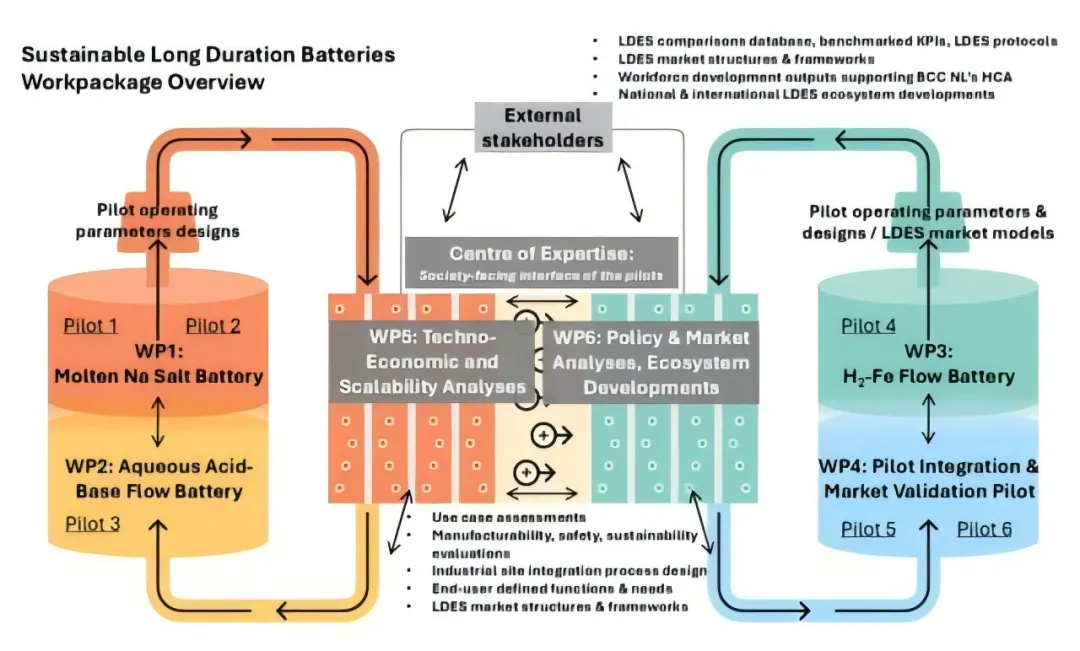
As part of the project,AQUABATTERY BV will develop a 50 kW saltwater acid-base power module prototype with 10 hours of storage duration.The company’s flow battery uses a three-tank system consisting of an acid tank,a base tank,and a neutral saltwater tank.During charging,electrical energy splits the saltwater into separate acid and base solutions stored in their respective tanks.During discharge,the acid and base are recombined in the cell stack to generate electricity,regenerating the neutral saltwater.This design decouples power(cell stack)from energy capacity(tank size),enabling flexible,long-duration energy storage using safe,abundant,and non-toxic materials.
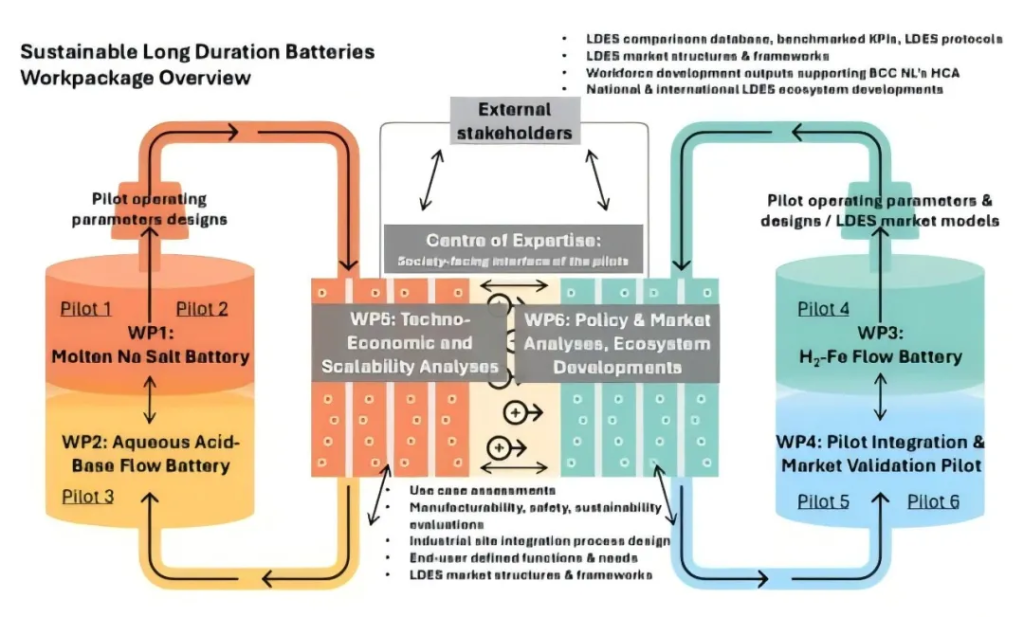
Elestor BV will install a 100 kW–1 MWh hydrogen–iron flow battery pilot.In this flow battery,hydrogen and iron‑based electrolytes are stored in external tanks and circulated through electrochemical cells separated by a membrane,decoupling power and energy capacity so the system can be scaled for multi‑hour to multi‑day storage durations.The use of abundant,low‑cost materials like hydrogen and iron makes the technology more affordable and sustainable for grid‑scale applications compared with conventional batteries,supporting integration of renewable energy and grid stability.
Finally,Exergy Storage BV aims to deliver a 1–2 MWh molten sodium-salt battery container,with an estimated 50 kW power output.Operating at high temperatures to keep salts molten,the battery stores energy through reversible chemical reactions,with power determined by the cell stack and energy capacity by the amount of molten salt.The technology avoids scarce or toxic materials and supports closed material loops and recyclability.
“All systems will be grid-connected and address three key use cases:electrification of industry,stabilizing grid fluctuations caused by variable green electricity supply,and deployment of small modules in the range of 10–20 kWh per module,”Van Bennekom says.
The consortium is planning five pilot projects,three of which focus on industrial implementation.“All pilots will be tested in relevant environments and in a systematic manner,enabling potential end-users to compare performance and results effectively,”Van Bennekom says.
There is a lot of work ahead on scaling up these battery technologies,including optimization of critical components such as electrodes,membranes,stack designs,container configurations,and power electronics and management systems to enhance performance,efficiency,safety,and scalability.The final goal of the pilot integrations,however,is to develop safe,efficient LDES deployment for industrial users while collecting performance and cost data to validate a new front-of-meter market model and long-duration system architecture.