Factories that make essential materials like steel and cement need scorching-hot air and steam to transform raw ingredients into finished products. Traditionally, they get that heat by burning fossil fuels. But the startup Electrified Thermal Solutions is pursuing a far cleaner approach: tapping piles of bricks.
The Boston-based company has developed a thermal battery system that uses electricity to heat metal-oxide firebricks for hours at a time. The goal is to soak up wind and solar power from the grid during cheaper off-peak periods, then deliver the stored heat to industrial furnaces, boilers, and kilns whenever manufacturers need it.
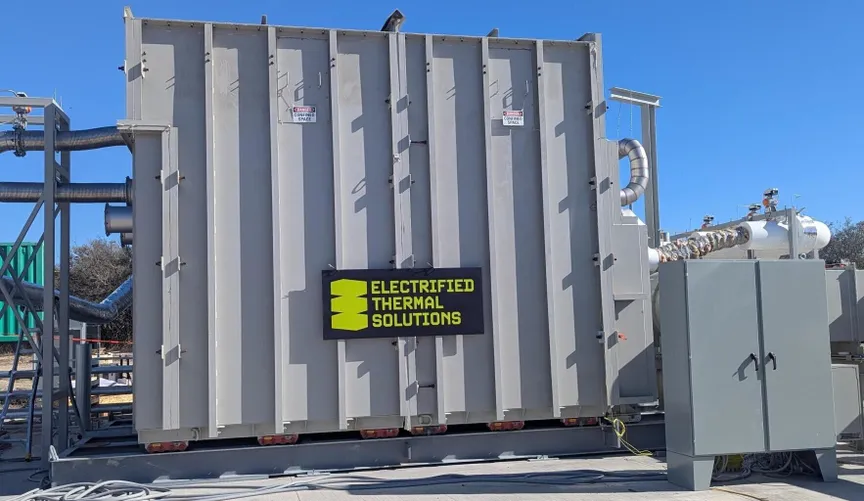
Now, Electrified Thermal is putting its technology to the test. Last week, the MIT spin-off unveiled its first commercial-scale thermal battery at the Southwest Research Institute in San Antonio. Its Joule Hive system can store 20 megawatt-hours of heat at temperatures of up to 1,800 degrees Celsius (3,270 degrees Fahrenheit).
“That is hot enough to do the job of fossil fuels in virtually any application,” said Daniel Stack, Electrified Thermal’s CEO and co-founder. “We’re talking about making cement, steel, chemicals, and glass, but also things like potato chips, which need steam generation for food processing.”
From the outside, the Joule Hive heat battery resembles a truncated shipping container connected to pipes and wires. Its insulated steel walls enclose stacks of firebricks, which are charged up by running clean electricity directly through them. The thermal energy is then discharged by running air through the brick stacks that can be piped as hot gas directly into factories.
The unit in San Antonio will allow manufacturers to “kick the tires” to see how the system works, including for on-site testing of minerals drying and other materials processing, Stack said. Electrified Thermal is poised to start delivering its first units to customers’ facilities at the end of this year or in early 2027, he added.
The startup is also partnering with ArcelorMittal to test the thermal-storage technology at the steelmaker’s R&D facility in Spain, and the two are considering piloting the system at a steel plant, where it could potentially replace the fossil-gas heat that is used to shape and strengthen the metal. ArcelorMittal and other global industrial giants, including cement-maker Holcim and iron-ore producer Vale, have invested in the firm.
“Industry has taken notice, and they’ve been very engaged in adopting electrified heating into their processes to try and reduce [energy] costs and cut emissions,” Stack said.
Electrified Thermal is one of more than two dozen startups that are attempting to clean up heavy industries by harnessing thermal storage, using not just specialized bricks but also materials such as crushed rock, molten salt, and sand. By banking low-cost renewable power from the grid, the firms aim to deliver heat that’s even cheaper than fossil gas — a formidable challenge for projects in U.S. regions where gas is abundant and inexpensive.
Thermal storage “has rapidly become one of the fastest-growing areas of interest within emerging storage technologies,” said Yiyi Zhou, a clean energy specialist at BloombergNEF, who added that the approach “offers its strongest potential in long-duration, heat-linked applications,” like the ones that Electrified Thermal has focused on.
Startups in this fledgling sector raised about $200 million in venture capital in 2025 from about a dozen disclosed deals, according to the consultancy Cleantech Group. In 2024, the sector raised close to $300 million — a total that includes a $150 million investment in Antora Energy, a California-based company that uses graphite blocks to generate intense beams of heat.
Electrified Thermal, for its part, says it has raised over $23 million in private capital since launching in 2021.
“It’s an exciting space, just given the overall need for electrified solutions in the sectors that thermal-energy storage companies are working in,” said Zainab Gilani, a research associate focused on energy and power at Cleantech Group. “The problem is definitely immense.”