Every few years, a chemistry paper wanders out of the lab, passes through a university press office, gets dressed up by a science news site, and lands on social media as if humanity is one strained molecule away from solving energy storage. The latest example is Molecular Solar Thermal storage, or MOST, in the form of a University of California Santa Barbara result that was quickly translated into claims about bottling sunlight in liquid form, storing it for years without leakage, and perhaps sidestepping the annoyances of batteries and critical minerals while everyone was at it. The chemistry is real. The molecular design is interesting. The implied relevance to useful energy storage is close to nil.
That gap matters because it is not unique to MOST. It is a recurring failure mode in science coverage. A legitimate paper reports a narrow result. The press summary emphasizes novelty and future possibility. The rewrite sites remove the constraints, keep the wonder, and imply practical significance that simply is not there. By the time the story reaches LinkedIn (where I saw it today) or X, readers are being invited to believe that a lab-scale molecular phenomenon belongs in the same conversation as batteries, pumped hydro, district thermal storage, industrial heat systems, or building energy infrastructure. It does not. That is why science clickbait sites should be read with a grain of salt the size of Australia. They are not usually inventing the science. They are inventing the importance.
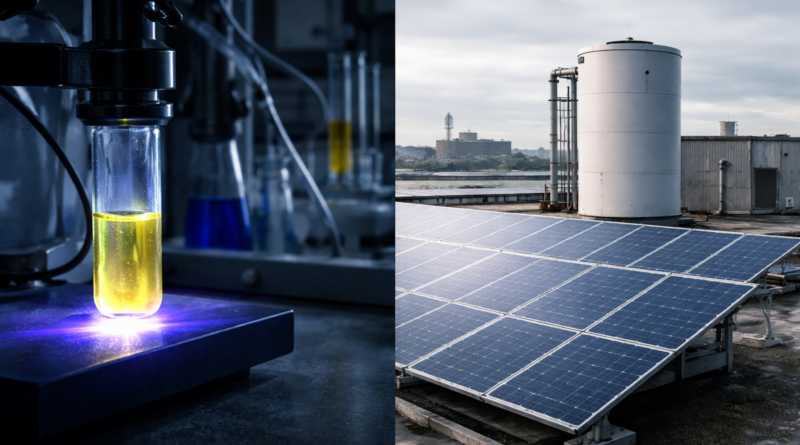
To be fair to the researchers, the underlying concept of MOST is neither silly nor fraudulent. A molecule absorbs light, changes shape into a higher-energy state, remains there for some time, and later returns to its lower-energy configuration while releasing stored energy as heat. That is the basic idea. It is not electricity storage. It is not a battery in the grid sense. It is not a substitute for a lithium-ion pack, a pumped hydro reservoir, or a thermal tank. It is a molecular heat storage mechanism. Those distinctions are not academic. In energy systems, the first question is always what useful service a technology delivers. If that question is skipped, a lot of nonsense gets smuggled in under familiar words like storage, battery, solar, and liquid.
The UCSB paper, as described in Science, focused on a DNA-inspired pyrimidone molecule. The team engineered a structure that could switch into a strained, higher-energy form under light excitation and remain metastable for long periods before releasing heat when triggered. The abstract reported a storage enthalpy of about 644 kilojoules per mole and an energy density of roughly 1.65 megajoules per kilogram. Converted into the units energy people actually compare, that is about 0.458 kWh per kilogram of storage medium. For molecular engineering, that is a respectable number. For a practical energy storage system, it is where the trouble begins, not where it ends.
Before getting into why the practical relevance is weak, it is worth being clear that the chemistry itself is impressive. Designing a molecule that absorbs light, flips into a metastable form, stays there without rapidly relaxing, survives cycling, and releases heat on command is hard. Doing that in a medium that avoids some of the awkwardness of earlier systems is also hard. The UCSB result appears to push forward on stability and controlled release in a real way. Chemists should care. Materials scientists should care. People who enjoy clever molecular design should care. The issue is not whether the work is interesting. The issue is whether it has anything to do with useful energy storage at the scale and in the contexts implied by the coverage. That is where the answer turns from yes to no.
The first place the story falls apart is the wavelength. The paper reports excitation at 300 nanometers. That is ultraviolet light, not the friendly, abundant part of the solar spectrum that makes rooftop solar work. It is right at the short-wave edge of what even reaches the Earth’s surface through the atmosphere. Surface sunlight is not an undifferentiated flood of equal photons. The atmosphere filters short-wave ultraviolet heavily. Roughly 3% to 5% of terrestrial sunlight is ultraviolet at all, and about 95% of that ultraviolet is UVA in the 315 to 400 nanometer range. The region around 300 nanometers is a tiny sliver of the sunlight that reaches the ground.
That one fact should have been enough to stop the phrase “bottled sunlight” from leaving the first rewrite desk, because while it is technically true in the narrowest possible sense, it is practically misleading. A molecule that responds to a tiny ultraviolet slice near 300 nanometers is not harvesting sunlight in the way any engineer, energy planner, or building operator would understand the phrase. It is harvesting a spectral fragment. If a system depends on a vanishingly small part of the incoming solar resource, it begins life energy-starved.
The arithmetic is not complicated. Take a standard rule-of-thumb figure of 1,000 watts per square meter for strong midday sunlight at the surface. The share in the narrow region near 300 nanometers is only a very small fraction of that. Depending on assumptions about exact band width, atmospheric conditions, and solar angle, a plausible order of magnitude is around 0.01% to 0.1% of total surface solar power. That implies perhaps 0.1 to 1 watt per square meter of incident energy in the useful band before any real-world losses. Even if the molecule were perfect at absorbing and storing that energy, which it is not, the available harvest is tiny. Add optical losses, packing density limits, incomplete conversion, and system inefficiencies, and the result is not a practical solar harvesting technology. Round trip sunlight to heat efficiencies would be in the hundredths of a percent.
Compare that with technologies that already do the solar job. Commercial PV modules routinely convert around 20% to 25% of a broad and abundant part of the solar spectrum into electricity. Solar thermal collectors directly capture substantial fractions of incoming solar heat. They do not need molecular choreography to do it. They need glass, pipes, absorbers, insulation, pumps, and plumbing. They work because they are aligned with the solar resource that actually arrives at the surface. By contrast, a system that starts with a few tenths of a watt per square meter of relevant incident energy is not competing in the same arena. It is not even playing the same sport. It is showing a photochemical trick, not building a viable solar energy system.
The second category error is even more basic. MOST returns heat, not electricity. That matters because electricity is a flexible energy carrier. It runs motors, electronics, lighting, chillers, trains, electrolyzers, and heat pumps. Heat is narrower. Low-temperature heat is narrower again. A technology that stores energy and only returns heat belongs in the category of thermal storage, not electrical storage. That shifts the comparison set immediately. The right peers are hot water tanks, phase change materials, underground thermal storage, borehole systems, pit storage, molten salts in some niches, ceramic media, and a handful of other thermal approaches. Once one compares MOST to actual thermal storage options instead of to batteries in general, the hype starts to look like costume jewelry next to structural steel.
Water is the obvious benchmark because it is cheap, available, non-toxic, and boring, which is a powerful combination in energy systems. The specific heat of water is about 4.2 kilojoules per kilogram per degree Celsius. Raise one cubic meter of water, which weighs about 1,000 kilograms, by 50 degrees Celsius and it stores about 210 megajoules, or roughly 58 kWh of heat. That is not theoretical. That is what ordinary hot water tanks do every day. If a commercial system needs low-grade heat shifted over hours or even days, a tank of water with decent insulation is difficult to beat. The molecule in the UCSB result stores about 0.458 kWh per kilogram. That sounds respectable until the full system is considered. The water tank is already a full system. The molecule is not. The water tank comes with steel, valves, controls, plumbing, safety familiarity, and a century of engineering practice. The molecule comes with a paper, synthesis, a trigger chemistry, and many unanswered questions.
Even at the level of raw stored heat, the comparison is not flattering once volume and system simplicity matter. Heating a cubic meter of water by 50 degrees Celsius stores 58 kWh of useful heat. To store the same amount of heat at 0.458 kWh per kilogram would require about 127 kilograms of the MOST storage medium, assuming ideal access to all of that stored energy. That may not sound bad on its face, but it ignores containment, solvent or medium considerations, heat exchange surfaces, trigger chemistry, regeneration loop, synthesis cost, stability under cycling, and the rest of the system. Water has the unfair advantage of being simple. In energy systems, simple wins a lot.
The story gets even weaker at larger scale. District thermal energy storage systems routinely handle thousands to millions of kWh of heat using pits, tanks, aquifers, or boreholes. The reason they do not use elaborate molecules is not lack of imagination. It is because dirt, rock, water, and insulated reservoirs are already very good at holding low-value heat. A seasonal pit storage installation can hold huge amounts of thermal energy at low cost per kWh. Exact numbers vary by design, but they are often a small fraction of the cost of electrochemical storage per unit of energy capacity. For district systems, the economics reward cheap media, large volume, and low complexity. MOST offers none of those things in its present form.
That is why the battery framing is so misleading. A good lithium-ion system returns electricity with round-trip efficiency often around 85% to 95% depending on the system and use case. It plugs into the grid or behind-the-meter assets directly. Its service is clear. Its cost curves are known. Its balance-of-system is understood. MOST does not return electricity at all. Even asking whether it beats lithium-ion is already evidence that the discussion has gone off the rails. It is like comparing a fancy blender to a knife because both are used in kitchens. The overlap is real but not useful.
The third place the practical case gets shaky is the release mechanism. In the reporting around the UCSB result, rapid heat release was triggered using hydrochloric acid. Hydrochloric acid is not exotic, and it is not costly in bulk commodity terms. Industrial pricing in recent market reports has been on the order of roughly $100 to $200 per ton in North America, sometimes lower in other regions. That means the price of the acid itself is not the problem. The problem is that using corrosive acid as part of a release and regeneration cycle is a giant engineering flag. It moves the concept away from the social-media image of a benign, elegant “liquid battery” and toward the reality of pumps, metering, corrosion-resistant materials, pH management, separation, neutralization, and maintenance.
This is where a lot of miracle-energy stories die when exposed to process engineering. The lab result is about what the molecule can do. The real system is about everything else required to make that behavior repeatable, safe, cheap, durable, and useful. If acid is added to trigger release and then the system has to be neutralized or otherwise reset to regenerate the original state, the question stops being “is HCl cheap” and becomes “why would anyone choose this process loop over a tank of water, a phase-change block, or a standard thermal store.” Most of the time, they would not.
The acid cost alone is not fatal. Even a rough conservative estimate suggests the reagent cost per delivered kWh-thermal could be low enough not to dominate. But cost per kilogram of input chemical is not the metric that decides adoption. Installed system cost, materials compatibility, maintenance intervals, hazard management, throughput, cycle life, and operational simplicity are. In that comparison, the acid-triggered molecular system starts behind and stays there.
The same applies to the “it boiled water” talking point. That line made the rounds because it sounds like instant relevance. In reality, it proves only that the stored energy can be released quickly enough in a small experimental setup to push a sample of water to boiling. That is a fine lab demonstration. It is not an answer to questions any engineer would ask. What temperature can the system sustain? At what flow rate? For how many cycles? With what degradation? Through what heat exchanger? At what delivered cost per kWh? Under what ambient conditions? Against what load profile? “Boiled water in half a second” is the kind of line that sounds like a product when it is still only a result.
Useful heat is not one thing. Domestic hot water commonly wants around 50 to 60 degrees Celsius. Many low-temperature industrial processes want 80 to 150 degrees Celsius. District networks vary widely. Some applications need steady output. Some need bursts. Some need daily cycling. Some need seasonal retention. A lab demonstration of heat release tells us almost nothing about where a system lands in that space. The absence of application-grade data is not a minor omission. It is the difference between science and product.
The phrase “no leakage” deserves its own cold shower. What appears to be true is that the high-energy isomer is metastable for long periods. That is meaningful science. It is not magic. The system still has to collect light, undergo conversion, be triggered, release heat, be reset, and survive cycles. Entropy was not repealed. Losses were not abolished. The researchers appear to have done well on molecular stability. That is all that claim should mean. The social-media translation turns that into an imagined victory over the compromises of real energy systems, which is where the nonsense enters.
A better way to think about the UCSB result is as an advance in a subfield of photochemistry, not an advance in useful energy storage. That phrasing is less sexy and more accurate. It also helps clarify what “useful” means in this context. If a technology is going to matter in energy infrastructure, it has to deliver an actual service at a competitive cost with acceptable complexity. The service might be electricity shifting, low-temperature heat storage, seasonal thermal balancing, industrial process heat, or something else concrete. MOST in this form does not make a compelling case on any of those fronts.
This is where the incumbent technologies become important, because they are not theoretical foils. They are already in the field. A household or commercial building that needs thermal storage can use insulated hot water tanks. A district system can use pits, boreholes, or aquifers. A building with electrified heating can use a heat pump and store the resulting heat in water or structure. Industrial processes can use conventional thermal buffers suited to their temperature range. If the need is electricity, then batteries, transmission, demand response, thermal flexibility, and in some cases pumped hydro already exist. The hard part of the energy transition is not waiting for exotic molecules to rescue us. It is deploying and integrating the solutions that already beat the alternatives on cost and performance in a growing set of cases.
That is one reason the social appetite for these stories is so unhelpful. They flatter the reader with the idea that the world is one clever paper away from escaping the dull work of infrastructure. But the energy transition is mostly about doing ordinary things at huge scale. It is about wires, substations, transformers, heat pumps, hot water tanks, insulated pipes, reservoirs, batteries, steel, aluminum, software, permitting, market design, and the institutions required to build and operate them. A strained molecule stable under ultraviolet excitation is a clever result. It is not a substitute for competence.
None of this means the research lacks value. Science does not have to produce a utility-scale product to be worth doing. The molecular architecture, switching mechanism, and stability behavior could matter within chemistry or materials science in ways that are hard to predict from the outside. Specialized niches may emerge where compact molecular thermal storage has some role. Stranger things have happened. But serious analysis has to start from the evidence in hand, not from the emotional effect of a headline. The evidence in hand says that this is a neat molecular system with a narrow optical trigger, thermal output, acid-assisted release, and no visible path to material relevance in practical energy storage markets.
It is worth observing that this pattern repeats because the media ecosystem rewards it. University communications offices are rewarded for attention. Rewrite sites are rewarded for clicks. Readers reward stories that promise a deus ex machina. “Interesting photochemical storage behavior in a DNA-inspired pyrimidone” does not go viral. “Scientists bottle sunlight in a liquid for years” does. The result is a public discourse that repeatedly mistakes a new part for a new machine. That is not a harmless error. It distorts expectations, confuses policy conversations, and weakens trust when miracle stories fail to turn into infrastructure.
The way out is not cynicism about science. It is better habits of interpretation. Ask what energy form goes in and what form comes out. Ask what fraction of real-world energy input is even available in the relevant band or condition. Ask what the system has to compete against. Ask what ancillary chemicals, hardware, and controls are needed. Ask whether the whole package beats the boring incumbent. Those questions are blunt, but they work. Most miracle stories collapse under them. MOST does.
Apply that discipline here and the answer is straightforward. The molecule stores energy after excitation at about 300 nanometers, a tiny and poorly supplied slice of terrestrial sunlight. It returns heat, not electricity. The headline energy density is respectable for molecular chemistry and unpersuasive against mature thermal storage options once system realities are included. Rapid release depends on a process step involving hydrochloric acid or equivalent triggering, which adds complexity and corrosion management. The lab demonstration of water boiling shows controlled heat release and says little about useful service delivery. No one has shown a system that competes with solar thermal collectors, hot water tanks, district heat stores, or batteries for meaningful practical roles.
That is why the respectful conclusion is also the firm one. The UCSB paper deserves attention as an elegant piece of molecular engineering. It does not deserve to be mistaken for a useful energy storage breakthrough. The science is real. The importance assigned to it by clickbait science coverage is not. Read the paper if you are interested in photochemistry. Read the headlines with a grain of salt the size of Australia.