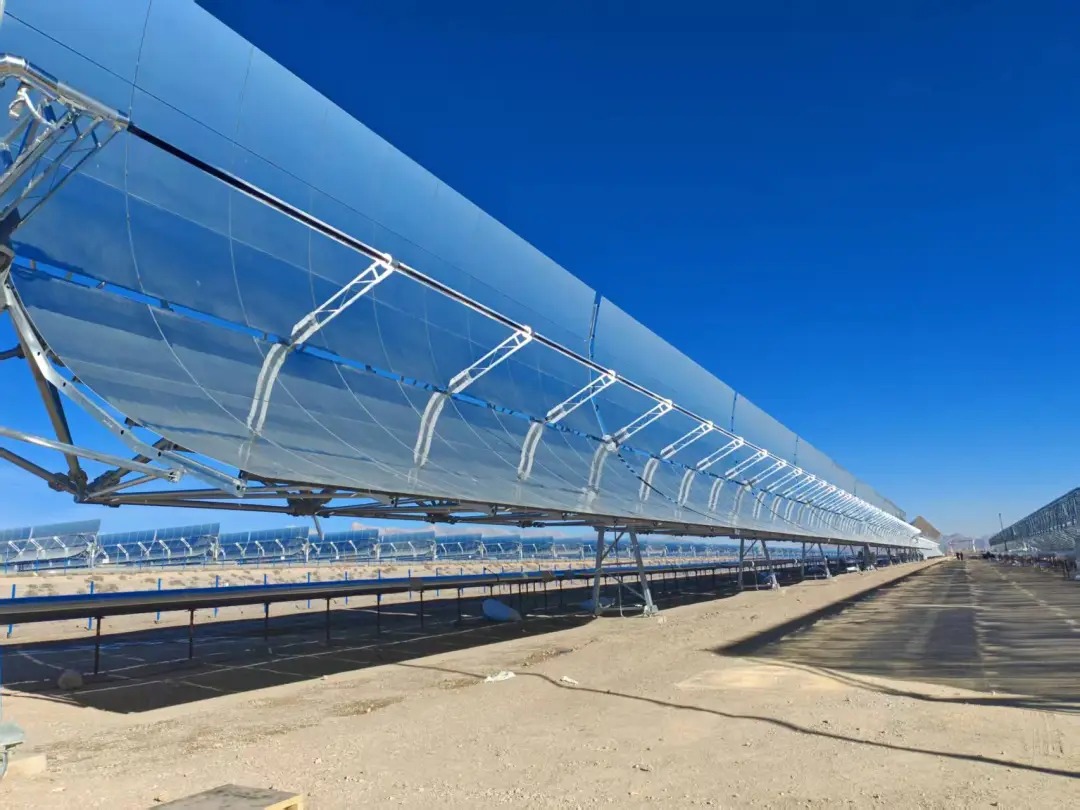
On April 21, the 8.6-meter-aperture molten salt parabolic trough collector system and integrated process, independently developed by China General Nuclear Power Group (CGN), successfully completed technical validation at the CGN Solar Thermal Test Base pilot platform in Delingha City, Qinghai Province.
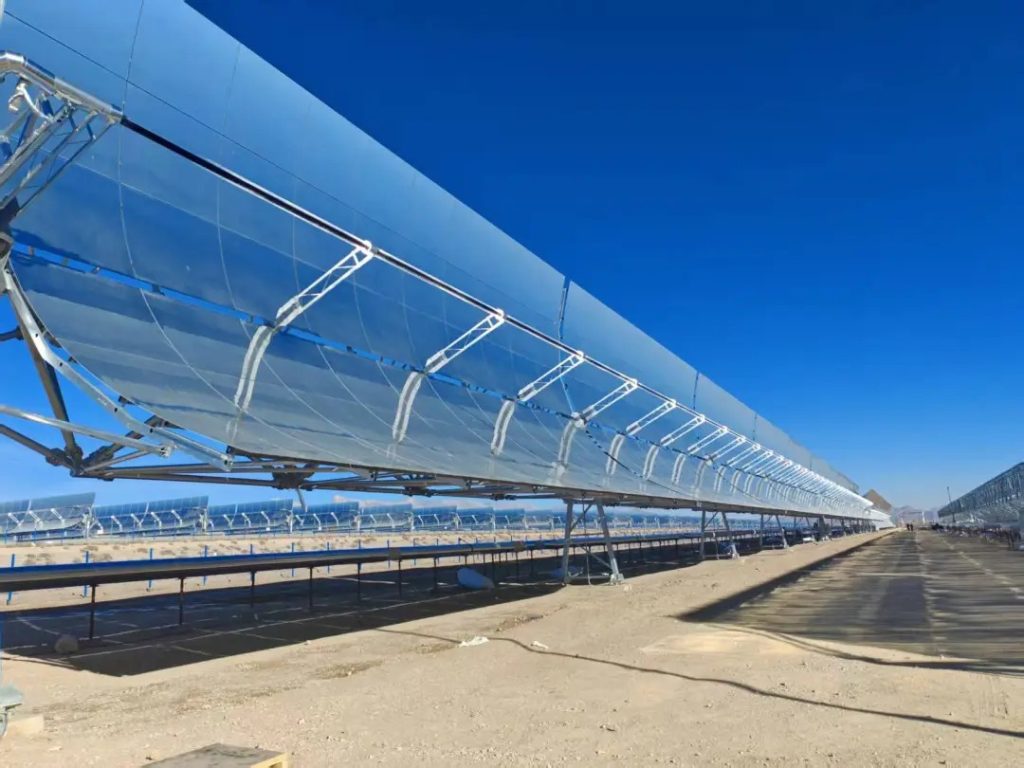
This milestone marks China’s full mastery of core molten salt trough collector technologies, laying a solid foundation for the large-scale deployment of domestic molten salt parabolic trough solar thermal projects and providing a “CGN solution” for the global advancement of the concentrated solar power (CSP) industry.
The pilot platform consists of a parabolic trough collector system, thermal energy storage system, and steam generation system. It is currently the world’s largest standard molten salt parabolic trough collector testing system in terms of aperture size. As the core component, the collector system adopts a standardized modular design, with a total effective collecting area of 5,970 m². It comprises four collector loops, each 182 meters in length with an aperture of 8.6 meters.
The system uses molten salt as the heat transfer medium, achieving a concentration ratio of 107.5. It enables stable operation with an inlet temperature of 290°C and an outlet temperature of 550°C, resulting in a thermal storage temperature difference of 260°C—2.6 times that of conventional heat transfer oil systems—significantly enhancing grid load-following and peak-shaving capability.

Since its commissioning in December 2025, the system has completed operational tests under typical seasonal conditions, including the winter solstice and spring equinox. The maximum collector temperature reached 574°C. It also demonstrated stable performance under extreme conditions, including temperatures as low as -23°C and wind speeds up to level 9. Third-party testing confirmed that both the optical efficiency of the collector units and the thermal efficiency of the loops meet design specifications, validating system stability, structural integrity, and all-weather operational capability.
Key equipment of the system—including collector supports, flexible connection components, local controllers, and high-precision support structure shape inspection devices—was developed through coordinated efforts led by CGN and domestic industrial partners, achieving 100% indigenous control over core technologies. The collector structure adopts a spatial truss design, while the flexible connection components use an integrated one-piece forming process. The local controller enables integrated intelligent management, and the structural accuracy inspection system is based on laser 3D scanning technology with internationally leading precision.
To address operational challenges in molten salt parabolic trough systems, CGN has also conducted systematic R&D on key processes and technologies, including collector tube preheating, high-flow gas purging and compressed air salt discharge, drone-based inspection, anti-freezing system design, and impedance heating. These developments have resulted in a complete and validated set of equipment and operational solutions, successfully demonstrated on the pilot platform.