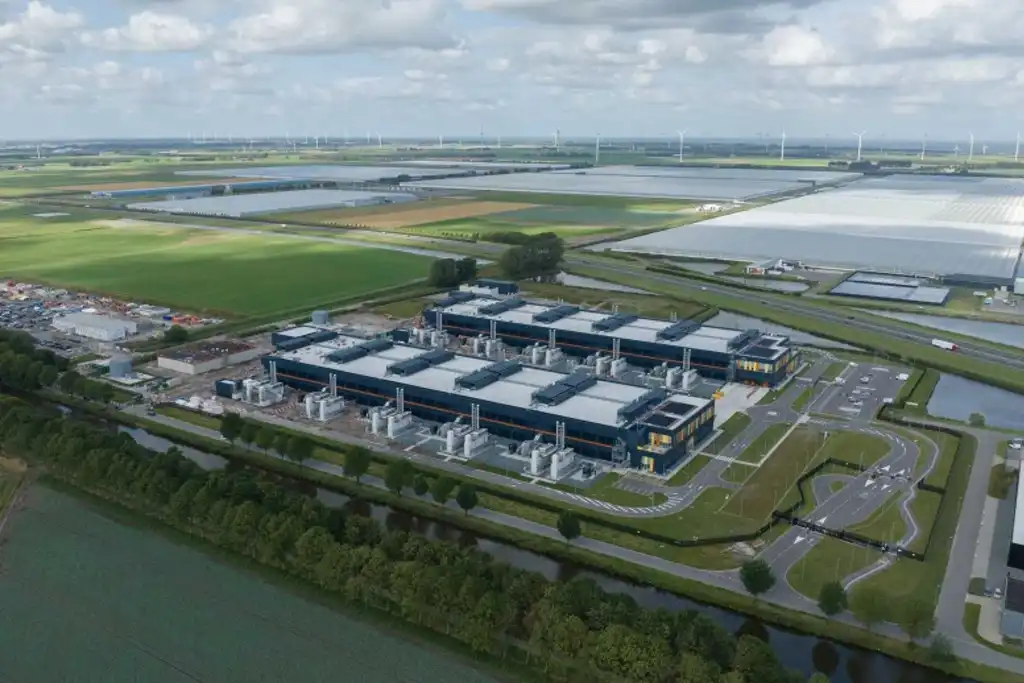
Artificial intelligence loads have a volatility issue. An 180 megawatt AI data center, for example, could have eight power swings of 60 MW in only one minute. Jon Parrella, CEO of flow batteries manufacturer Terraflow Energy, says that’s a “huge problem” that’s going to become progressively worse; as AI data centers grow into the gigawatts, the size of their power swings will increase with them.
“Multiple 100 MW swings multiple times a minute will trip airbreakers at the substation feeding the grid, which will then create a rolling blackout event,” Parella told Latitude Media. “And if you put a generation asset in between, it’s the equivalent of driving a Ferrari 80 miles an hour down a highway, shifting from first gear to fifth over and over again.”
It’s inefficient, doesn’t quite work, and risks “torching” the generation assets, something that hyperscalers are already struggling with, according to Parrella.
To solve the problem, Texas-based Terraflow Energy wants to place large, grid-scale flow batteries between the data center and the power source, acting as a filter to absorb the load volatility. The same system would also provide the data center with backup power when needed and filter out any harmonic distortion, aggregating some functions that data center developers typically install separately.
The company, founded in 2024, is developing a 9.6 MW, five-hour project in Bellville, Texas. According to Parrella, it has also secured a one-gigawatt storage commitment for an undisclosed Port of Victoria project, and is in discussions with roughly four gigawatts’ worth of additional data-center developments.
Its flow battery pitch is part of a nascent trend of grid-scale battery manufacturers pursuing alternatives to lithium-ion batteries, as the combination of favorable tax credits and the booming data center market create unprecedented demand for energy storage, even amid an otherwise lukewarm clean energy market.
While still unproven at scale, flow batteries could be a campus-level addition to what hyperscalers are already doing to try and smooth AI loads at the rack level. Google, for example, has been installing lithium-ion battery backup units directly on its data centers’ racks to absorb the smaller power fluctuations at the server level, while Nvidia has been redesigning its chips to minimize volatility from the get-go.
Flow battery as a ‘filter’
Terraflow’s system uses a standard flow-battery architecture: Large tanks of electrolyte feed into electrochemical cell stacks mounted in open, container-sized industrial frames, where the charging and discharging reactions occur. In its current iteration, each module holds 24 stacks for a total power output of about 1.25 megawatts, which can be tied together and paired with million-gallon electrolyte tanks to form 25 MW building blocks. Each block delivers roughly 10 hours of storage.
So, as CTO Ian Rock explained, the novelty in Terraflow’s approach and the core of its intellectual property isn’t in its underlying chemistry so much as in where and how the system is integrated.
“Instead of having a data center and having a battery, and switching on the battery when the grid goes off, we run through the battery permanently,” Rock said. “The battery permanently forms and filters the power source. It’s a completely different implementation than is typical in the market.”
To achieve this “permanent filter,” Terraflow places its flow battery system between the distribution transformer and the data center itself. It then separates the two pieces of equipment that convert electricity back and forth between AC and DC power, putting one on the grid side and one on the data center side and forcing any electricity flowing to the data center to go through the flow battery. As a result, the chemistry reacts instantly to changes in load, absorbing energy when demand dips and releasing it when demand spikes so that, from the grid’s perspective, the data center looks like a flat load.
None of this requires any switching, Rock clarified; instead, “the system responds at the speed of a natural chemical reaction.”
Challenging lithium-ion
A similar filtering function can be performed by lithium-ion storage systems, which are far more widespread. Energy storage company FlexGen, for example, which is already well-established as a company and has several gigawatts of deployments under its belt, pairs large lithium-ion storage systems with control software to smooth load swings.
But, Parrella says, lithium-ion batteries have a degradation problem. “When you use lithium-ion in a state where you’re constantly charging and discharging it, you heat up the lithium-ion cells, and the lithium-ion degrades much faster,” Parrella said, adding that flow batteries also have the advantage of being nonflammable, so they can be placed closer together and occupy less space.
The vanadium electrolyte, on the other hand, which is the chemistry that Terraflow is currently using to power its flow batteries, doesn’t degrade and can be recycled indefinitely.
It is, however, more expensive, and much of the world’s supply has historically come from places like China and Russia, factors that have slowed the technology’s adoption and pushed other companies to explore cheaper, organic flow-battery chemistries. But Parrella is not “terribly worried about being able to get vanadium supply,” noting that in July Terraflow signed a supply agreement with Storion Energy, which controls vanadium mines in Brazil and Peru.
“Yes, it’s a little bit more expensive than some of the other chemistries, but [given] what the data centers need, the amount of money they’re spending on the critical infrastructure, and the fact that this solves all their problems, money is not the issue,” Parrella said. Plus, he added, the company is “somewhat chemistry agnostic,” and is also prototyping an organic chemistry it could pivot towards if needed.
Rather than vanadium supply, Terraflow’s “biggest obstacle,” according to Parrella, is the first-of-a-kind technology risk in light of the dominance of lithium-ion, a more familiar and bankable technology that continues to make significant progress in terms of scale, duration, and economics. That puts Terraflow at a disadvantage with data centers and other large-load customers, who tend to default to lithium-ion because it’s well understood and easier to finance as part of a larger project.
“Our biggest thing is, if they say they want to go with lithium-ion, our response is, ‘Come back to me in six months, once you’ve burned it out,’” he said.