On December 12, at its third Eco Day, HiTHIUM put a clear stake in the ground: the next era of electrochemical storage will depend not only on the speed of system deployment, but also by how reliably they can support a renewable-led power system. By launching a “native” 8-hour long-duration platform alongside a collaborative lithium–sodium, full-duration energy storage solution for AI data centres, the company is not simply adding products. It is proposing a new organizing logic for the market, one that treats long-duration storage as essential infrastructure for modern grids, rather than a bolt-on for peak shaving.
A market moving beyond “short duration”
For much of the past decade, 2 or even 4-hour systems became the industry’s default. They were the easiest commercial pathway: bankable, widely understood, and well matched to early balancing needs. But the world has changed. Electrification is accelerating, data centres are multiplying, renewable penetration is surging and stabilized clean energy is now central to energy security and affordability. When the system challenge shifts from “hourly optimisation” to “daylight-to-night” firming, conventional short-duration storage increasingly feels like a partial solution.
HiTHIUM’s answer is to make 8 hours not an exception, but a baseline. Its core message is strategic: if grids are to run on “all-weather green electricity”, storage must be designed around longer duty cycles from the outset, so that economics, efficiency and safety reinforce one another rather than compete.
“Native” 8-hour design as a turning point
The company’s decision to frame ∞Power8 6.9MW/55.2MWh as a “native” 8-hour solution is more than branding. It reflects a conviction that long-duration performance cannot be optimised by simply scaling up a short-duration template. Instead, HiTHIUM is pushing a platform approach, built from cell to system for 8-hour operation, and intended to lower the total cost of delivered storage and raise confidence in long-life, long-cycle performance.

At a strategic level, this matters because long-duration storage is increasingly the missing link between ambitious renewable build-outs and the reliability expectations of industrial economies. In Europe, power systems must absorb higher shares of wind and solar while managing network constraints and stringent safety and environmental requirements. In the US, reliability has become inseparable from speed: permitting and grid upgrades take years, yet new load, from electrification to AI, arrives in months. A scalable 8-hour architecture becomes, in effect, a time machine for the grid: it unlocks more renewable utilization today, while buying breathing room for infrastructure to catch up.
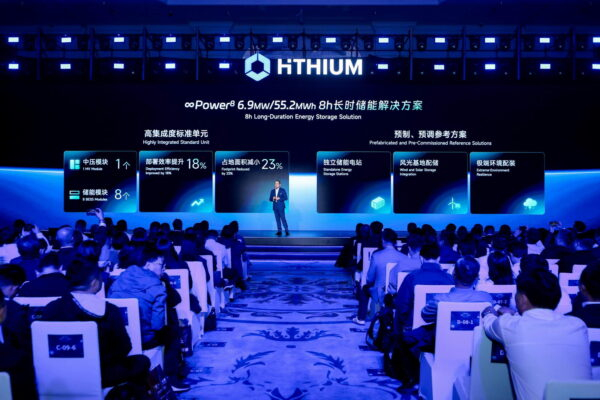
HiTHIUM is explicit about the priorities that will define this next chapter: economic competitiveness, operational efficiency, and safety as a non-negotiable baseline. The company’s emphasis on “functional reconstruction” and system-level intelligence is a deliberate shift away from incremental cost-down. It signals an industry maturing from hardware delivery to performance delivery—where value is measured not only in volume, but in reduced complexity, improved reliability, and faster, smoother project execution.
Why this matters in Europe and the US
HiTHIUM’s product direction aligns closely with what Western markets increasingly demand.
First, grid volatility is structural, not temporary. As renewables rise and load profiles become spikier, driven by electrification and high-density digital infrastructure, power systems need resources that can both buffer variability and provide firm capacity across critical periods. 8-hour storage is uniquely positioned to smooth the “solar-to-evening” transition, support intra-day shifting, and reinforce system stability.
Second, reliability is becoming a commercial requirement, not a technical aspiration. European and American buyers, including utilities, developers, and data-centre operators, are scrutinizing safety, lifetime value and operational predictability. HiTHIUM’s narrative of designing for long service life and full-lifecycle assurance speaks directly to this procurement reality.
The AI data-centre moment: energy meets compute
HiTHIUM’s most forward-looking innovation is its collaborative lithium–sodium, full-duration AIDC solution. Strategically, it recognizes that data centres are not just large consumers of electricity, they are a new kind of grid participant, with load behaviors that can be abrupt, frequent and system-critical. HiTHIUM’s framing is sharp: AI demand is evolving quickly, but power infrastructure evolves slowly; the gap must be bridged by an energy system that is fast, green, stable and economical.
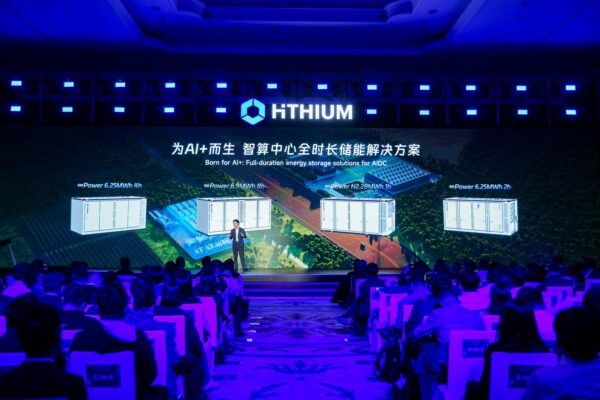
Here, the company’s philosophy becomes an architectural proposition: pair long-duration energy support with high-rate power response to form an “energy foundation” for digital civilization. In practice, this positions storage not only as backup, but as a tool for resilience—capable of absorbing shocks, enabling higher green-power penetration, and supporting next-generation power architectures.
A clear five-year ambition
HiTHIUM’s “135 Lighthouse Plan” gives the story a long horizon and a measurable ambition: push storage toward an era where it can compete on cost and lifespan alongside wind and solar and serve as a cornerstone of comprehensive electrification. The company is effectively saying: long-duration storage should not be a premium accessory. It should be a mass-market enabler of clean, reliable energy—industrial in scale, bankable in performance, and ready for the world’s toughest grids.
Taken together, HiTHIUM’s three launches represent a confident statement of intent. They point to a market that is moving beyond short-duration optimisation toward system-level reliability, and beyond isolated products toward integrated solutions. For Europe and the US, where decarbonisation must be achieved without compromising security of supply, this is precisely the kind of transition the energy system has been waiting for.