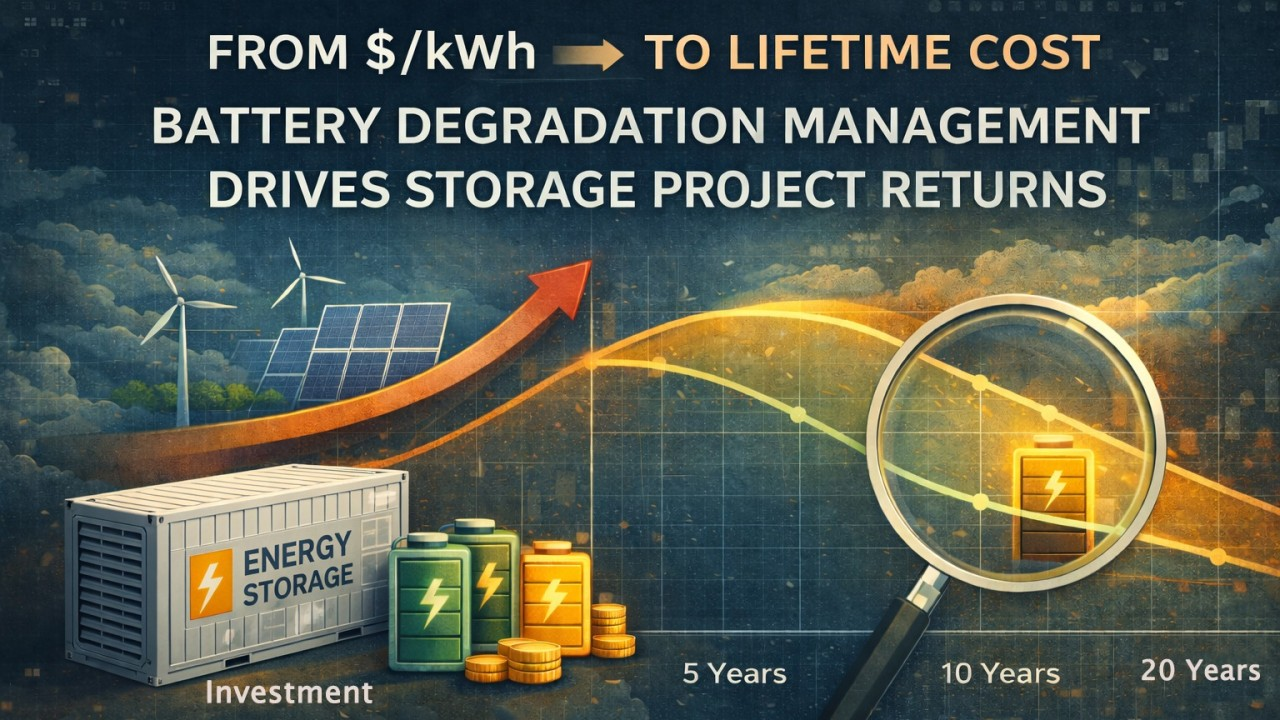
The Energy Storage Industry Is Shifting: From “Upfront Price” to “Lifetime Economics”.
Over the past two years, one question has dominated discussions in the energy storage industry:
“How much does your system cost per KWh?”
However, Morgan Stanley’s latest research on energy storage repeatedly emphasizes a very different conclusion:
For long-duration assets like energy storage, cost per cycle ($/cycle) matters far more than cost per kWh.
The logic is straightforward.
Energy storage is not a fast-moving consumer product. It is a long-life infrastructure asset, often designed to operate for 15–20 years. What ultimately determines whether a project is profitable is not how cheap the system is on day one, but:
- How many cycles the battery can actually deliver
- How much usable energy is retained in each cycle
- How quickly revenue erodes as capacity degrades
All of these factors converge on one long-underestimated metric:
Battery degradation control.
Same System, Different Degradation — A Project Can Live or Die
In its report, Morgan Stanley presents a highly “engineering-driven” scenario analysis. The system remains identical; only one variable changes: the battery degradation rate.
Two scenarios over a 20-year design life:
- Slow degradation: ~1% energy loss per year
- Fast degradation: 30% capacity loss in the first five years, followed by 1.5% annually

Using the CAISO market in California as an example—where storage revenues are diversified (capacity payments, energy arbitrage, ancillary services, environmental value, and the 30% Investment Tax Credit)—Morgan Stanley assumes:
- System CAPEX: USD 250/kWh
- Capital structure: 50% debt financing
Under these assumptions:
- Equity IRR reaches 38% in the slow-degradation case
- IRR drops to 27% in the fast-degradation case
An 11-percentage-point gap, driven solely by degradation behavior.

Morgan Stanley then makes an even more striking observation:
If a fast-degrading battery is used, the system must be USD 50/kWh cheaper upfront just to match the return of a slow-degrading battery.
This helps explain a common industry phenomenon: Why do storage systems with similar specifications show large price differences?
The answer is not who is “pricing aggressively,” but whose battery loses capacity more slowly over time.
China: The Most “Unforgiving” Test Ground for Battery Degradation
Morgan Stanley also analyzes China’s commercial and industrial (C&I) storage market, where:
- Revenue streams are limited
- Capacity payments and environmental premiums are largely absent
- Income is primarily driven by peak–valley electricity price arbitrage
Under a required 20% IRR:
- Fast degradation requires system costs below USD 75/kWh
- Slow degradation allows costs up to USD 105/kWh
At a system cost of USD 100/kWh:
- Unlevered IRR reaches 12.6% under slow degradation
- But falls to just 7.1% under fast degradation


At this point, the issue is no longer “earning more or less” — it is whether the project is financially viable at all.
China’s C&I storage market may be the most unforgiving examination room in the world, and battery degradation rate is the exam question.
Battery Performance Evidence from Real-World Data
Morgan Stanley’s report also discloses its independent battery performance research.
Using ride-hailing data from four Tier-1 Chinese cities, the study analyzed 100 samples across 12 electric vehicle models. The results show significant variation in degradation performance, reflecting differences in:
- Battery interface optimization
- Lithium replenishment strategies
Notably, the two models equipped with CATL batteries exhibited the slowest degradation rates among all samples.

In addition, Morgan Stanley references the Zhangbei National Wind–Solar–Storage Demonstration Project, one of China’s earliest large-scale storage installations. Among four LFP battery suppliers involved:
- Only CATL batteries have never been replaced
- After 14 years of operation, capacity remains at approximately 90%
- Other suppliers experienced large-scale replacements or early retirement
Final Thoughts
If storage is judged purely by tender prices, it appears to be an increasingly low-margin business. But when the time horizon extends to 10 or 20 years, it becomes a far more brutal one.
Because eventually, all questions reduce to a single outcome:
Can your battery continue to generate stable cash flow?
Morgan Stanley’s report signals a quiet but decisive shift in the industry — from speculative deployment back to engineering fundamentals and physical reality.
Fast-degrading batteries may not be eliminated on day one. But they are eliminated by cash flow in year three, five, or eight — and ultimately voted out by asset owners, lenders, and operators alike.
This is why investor questions are changing:
- Not just “How much cheaper are you?”
- But “Can you show me your degradation curve over 10 years?”
Battery degradation control increasingly defines cell value and pricing power. It reflects a manufacturer’s understanding of interface design, lithium compensation strategies, and the trade-off between energy density and long-term durability.
Cells may look standardized — but their economics are anything but.
As energy storage shifts from policy-driven deployment to asset-driven operation, battery degradation control itself is becoming the strongest brand signal of all.
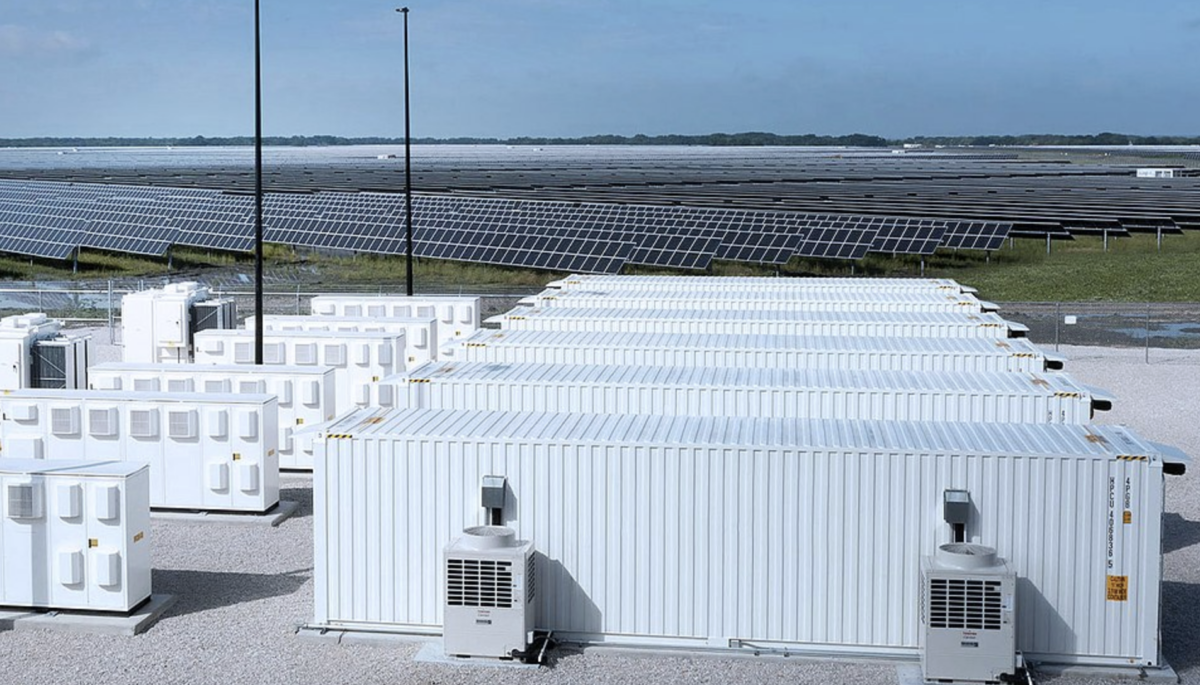
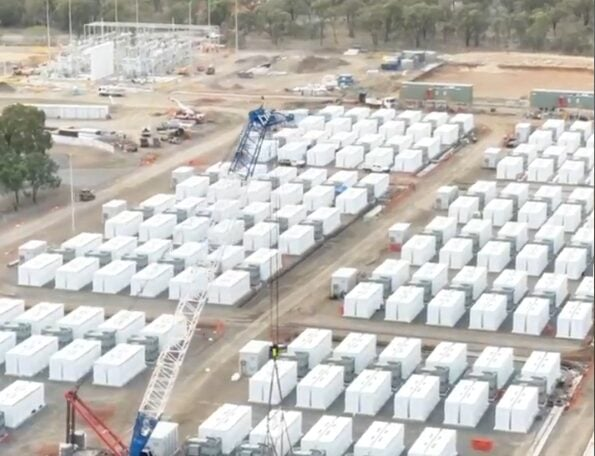

Morgan Stanley’s Latest Research: Battery Degradation Management Is a Key Determinant of Energy Storage Project Returns – ESPLAZA LDES Network
[url=http://www.g2fh5k26cx9615297qw9hc6aih6ogo34s.org/]uzbzyndkzx[/url]
zbzyndkzx http://www.g2fh5k26cx9615297qw9hc6aih6ogo34s.org/
azbzyndkzx
Morgan Stanley’s Latest Research: Battery Degradation Management Is a Key Determinant of Energy Storage Project Returns – ESPLAZA LDES Network
asnmyflqhe
[url=http://www.gcz9g1nl901o908989y3di7j3s4w2jims.org/]usnmyflqhe[/url]
snmyflqhe http://www.gcz9g1nl901o908989y3di7j3s4w2jims.org/