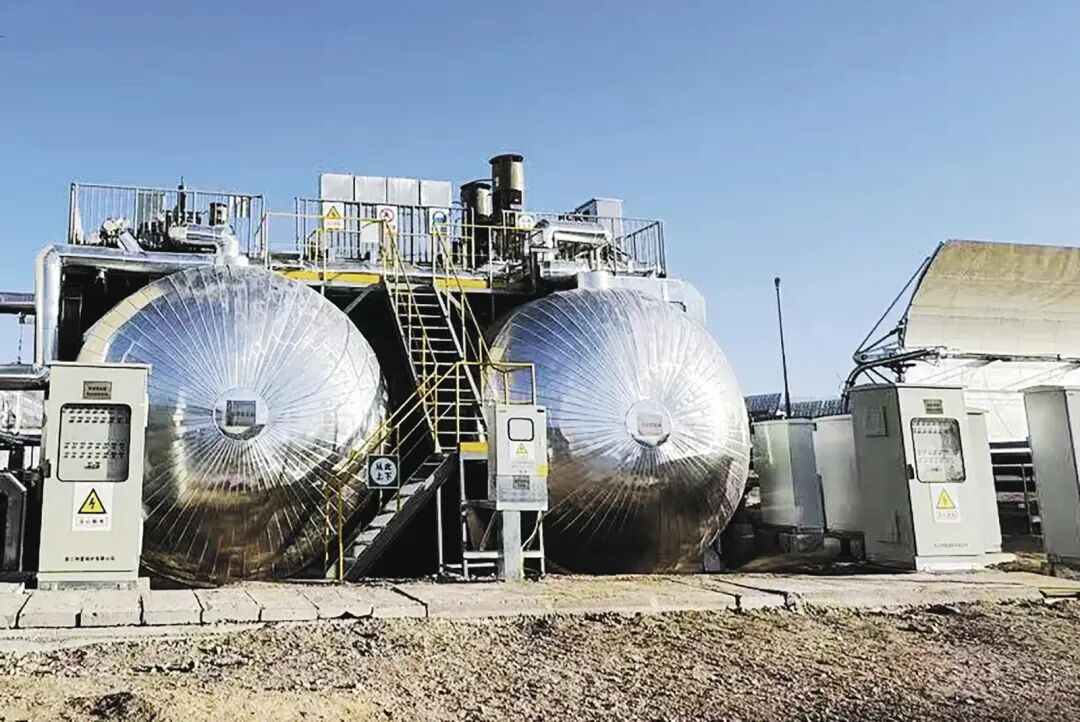
China General Nuclear Power Group (CGN) is making steady progress in comprehensive testing for its pilot project of a new-generation large-aperture molten salt parabolic trough collector for concentrated solar power (CSP) in Delingha, northwest China’s Qinghai Province. With a total R&D investment exceeding 100 million yuan, the project broke ground in May 2025, and is designed to fill China’s gap in large-aperture trough CSP technology systems, break free from path dependence on traditional trough technology, and break foreign technology monopolies in the sector through indigenous innovation, underpinning the high-quality development of China’s CSP industry.
Despite the lingering spring chill, the Photovoltaic Industrial Park at the west exit of Delingha, in Haixi Mongolian and Tibetan Autonomous Prefecture – a city whose name means “golden world” in Mongolian – is abuzz with the momentum of solar energy development. At CGN’s pilot base, rows of 8.6-meter large-aperture trough collectors stand tall like “sun-chasing warriors” facing the sun, their giant reflective mirrors glistening brightly in the sunlight.
“CSP is a critical technology to address the volatility of new energy and ensure the stable supply of green electricity,” said Yang Tao, General Manager of CGN Solar Delingha Co., Ltd. “CGN is leading the independent development of core equipment and carrying out pilot verification through this base, providing key support to break foreign technology monopolies in this field.”
Traditional trough CSP technology has long been constrained by two major bottlenecks: the temperature limit of thermal oil and high costs. Its low heat collection temperature and requirement for a high number of loops have restricted the large-scale development of the industry, Yang explained. In contrast, the new large-aperture trough technology uses high-temperature molten salt, with its heat collection temperature exceeding 550℃. This design effectively cuts molten salt consumption, enables integrated heat transfer and thermal storage, and significantly improves power cycle efficiency.
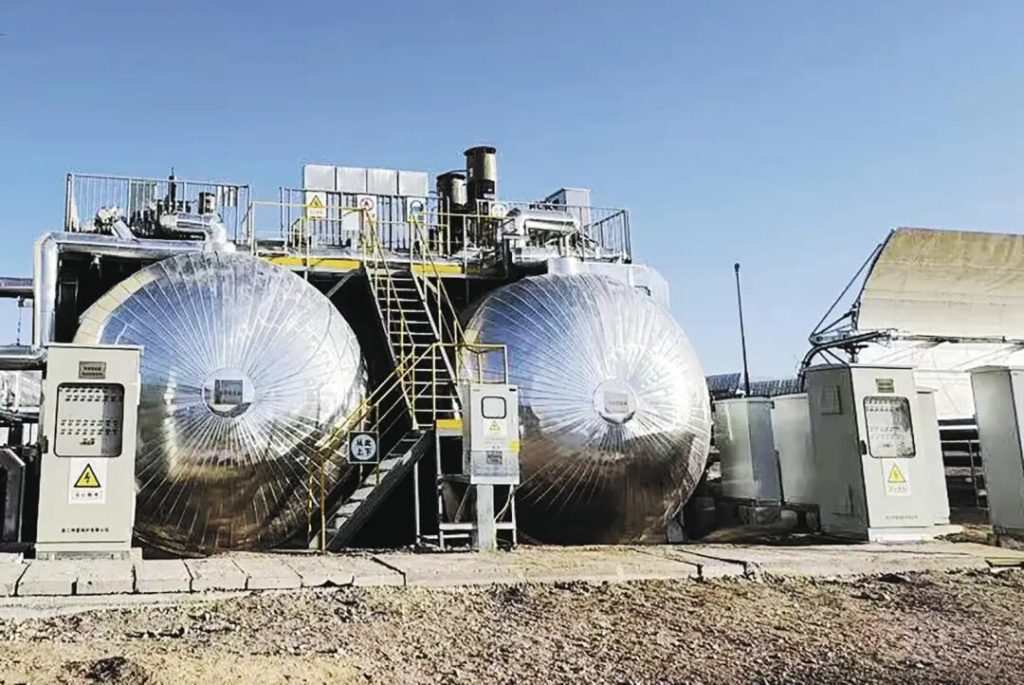
Meanwhile, the aperture length of the new collector is 49% larger than that of the mainstream EuroTrough (ET), the global benchmark for traditional trough systems. Like building a “giant light-concentrating stage” for sunlight, the expanded aperture effectively reduces the number of required loops, lowers construction and operation costs, and serves as a core technical route to drive down costs and boost efficiency for CSP plants.
This cutting-edge “sun-chasing technology” integrates multiple indigenous innovation achievements. Its “intelligent brain” is a complete set of design and analysis methods integrating optics, thermodynamics, and structural mechanics; a new high-rigidity support structure serves as its robust “skeleton”; and local controllers act as its precise “eyes”, enabling real-time tracking of the sun’s trajectory.
“We have achieved independent development of core equipment and key components for the project,” Yang noted with pride. “After rigorous testing and verification, multiple parameters of the large-aperture molten salt trough collector have reached internationally advanced levels. Among them, the intercept factor of the Solar Collector Element (SCE) hit 96.6%, and the loop heat collection temperature exceeded 550℃, fully verifying the high-temperature heat collection performance of our large-aperture molten salt trough technology.”
As the first rays of morning sun rise, the collectors in the solar field automatically activate their tracking mode, starting their day-long sun-chasing journey, and enabling the CSP plant to deliver continuous, stable power supply 24 hours a day.
According to the project team, the industrialization of the technology will be rolled out in three phases: first, completing the pilot verification; second, launching a 350 MW demonstration project in Golmud; and third, breaking ground on a 300 MW commercial project in Delingha, realizing the technology’s leap from laboratory research to engineering application and large-scale commercialization.
As a key development direction for trough CSP technology, the breakthrough of the large-aperture molten salt trough technology not only fills a domestic technical gap, but also provides strong support for the development of a new energy system.
From traditional thermal oil troughs to large-aperture molten salt troughs, and from technology introduction to indigenous innovation, Qinghai’s clean energy industry, set against the vast Gobi Desert, is continuously enriching its development models, deepening its development connotation, and making steady strides toward high-quality development.