As wind and solar development faced political and regulatory headwinds over the past year, the Trump Administration signaled renewed momentum for geothermal energy development. Despite imposing barriers to many clean energy projects, the Trump Administration has consistently treated geothermal energy favorably relative to other clean energy technologies. The passage of the One Big Beautiful Bill Act (OBBBA) in July 2025 limited or aggressively phased out several key tax incentives for solar, wind, and residential heat pumps, while largely preserving tax credits available for commercially leased geothermal heat pumps and thermal energy storage systems. At the same time, the U.S. Department of Energy (DOE) is offering major geothermal funding and research opportunities, and several bipartisan bills are making their way through Congress that seek to improve geothermal permitting processes. The overall favorable federal policy environment for geothermal energy has spurred substantial private investment and new innovations in geothermal technology.
In this post, we take a look at several DOE projects and funding opportunities, proposed federal legislation that aims to accelerate geothermal development, and what states are doing to continue the industry’s forward momentum.
Department of Energy Research and Funding Initiatives
The DOE has invested significant resources into geothermal energy research and development over the past several years. In November 2025, the DOE merged its geothermal office with its fossil energy office, creating the new Hydrocarbons and Geothermal Energy Office (HGEO), and folded the former Office of Energy Efficiency and Renewable Energy into the new Office of Critical Minerals and Energy Innovation. The agency’s new organizational structure reflects its policy priorities. Over the last year, the DOE has made several major announcements promoting geothermal development:
- On February 25, 2026, the DOE’s Office of Geothermal (formerly the Geothermal Technologies Office) within HGEO announced a $171.5 million funding opportunity to support next-generation geothermal field tests for both electricity generation and exploration drilling to support characterization and potential confirmation of promising next-generation and hydrothermal prospects. Individual awards may range between $4 million and $25 million; letters of intent are due on March 27, 2026, and full applications are due on April 30, 2026.
- In December 2025, the DOE awarded an $8.6 million grant to expand Eversource’s networked geothermal project in Framingham, Massachusetts, the first utility-led geothermal heating and cooling network in the nation. The DOE’s grant will allow the pilot project, which first came online in 2024, to double in size to serve an additional approximately 140 new customers.
- As we covered last year, the DOE’s Advanced Research Projects Agency-Energy (ARPA-E) announced a $30 million funding opportunity for superhot rock geothermal energy research (the “Stimulate Utilization of Plentiful Energy in Rocks through High-temperature Original Technologies” or “SUPERHOT” program). Selection notifications and awards for the SUPERHOT program are anticipated later this year.
- In January 2026, the DOE launched the Geothermal Power Accelerator, a 15-state strategy and policy effort led by the National Association of State Energy Officials (NASEO) to expand the use of geothermal power on the U.S. grid. State Energy Offices from Alaska, Arizona, California, Colorado, Hawai’i, Idaho, Louisiana, Montana, Nevada, New Mexico, Oregon, Pennsylvania, Utah, Washington, and West Virginia will collaborate with federal partners and industry leaders to identify solutions that drive geothermal investment and deployment.
Geothermal Permitting Bills Advancing Through Congress
While federal funding plays a meaningful role in supporting certain geothermal energy projects, federal permitting is another essential component of many large-scale geothermal projects. Most domestic hydrothermal resources are found in the western United States and are often located on federal lands managed by the Bureau of Land Management (BLM) under the Department of the Interior (DOI). Permitting timelines for geothermal projects on BLM-managed lands have historically taken as long as 7-10 years. Geothermal projects on federal land are particularly complex and can require multiple phases of environmental review under the National Environmental Policy Act (NEPA), including land use planning, leasing, exploration, drilling, and utilization operations, in addition to state and local agency requirements. Delays related to BLM’s competitive leasing process and agency staffing shortages are also common.
At a time when the electric grid needs reliable clean power more than ever—in large part due to AI-driven infrastructure and data center development—federal permitting reform has become a hot-button issue for the geothermal sector. In particular, alongside efforts to reform the NEPA process generally, legislators and regulators have considered new geothermal-focused categorical exclusions to NEPA that are intended to streamline geothermal permitting by allowing agencies to focus on the highest-impact actions within a multiphase geothermal development project.
On March 5, 2026, the House Committee on Natural Resources favorably reported, or recommended for consideration by the full House, eight bills addressing geothermal energy, six of which were reported with unanimous bipartisan support. These bills address various aspects of the geothermal permitting process, including DOI leasing and permitting practices, DOI’s cost-recovery authority, and the applicability of NEPA.
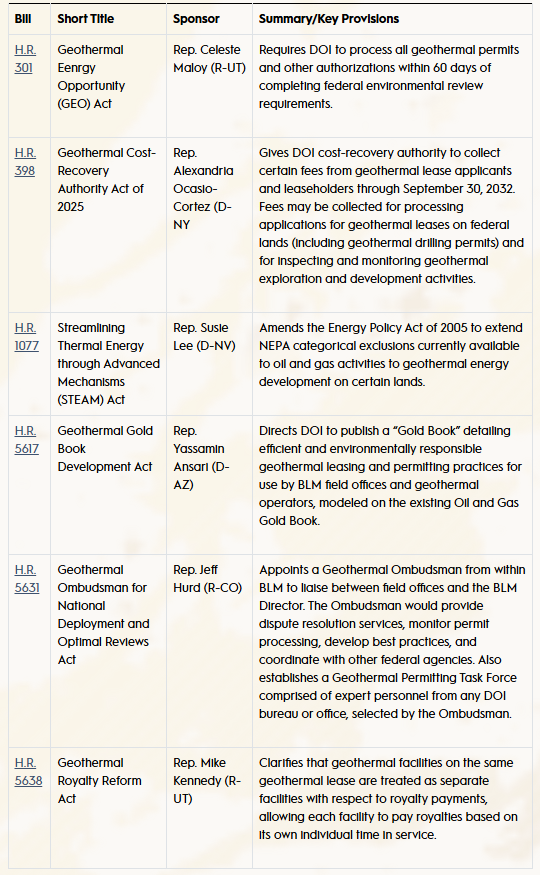
Among the geothermal bills considered by the House Committee on Natural Resources on March 5, two Republican-sponsored bills (both of which passed the House with bipartisan support in the 118th Congress) were reported favorably, but did not receive unanimous approval:
- H.R. 5576, the Enhancing Geothermal Production on Federal Lands Act (Rep. Russ Fulcher, R-ID) would create a NEPA carve-out for “low-impact” geothermal exploration projects that would allow certain initial drilling activities to occur without an environmental assessment.
- H.R. 5587, the Harnessing Energy at Thermal Sources (HEATS) Act (Rep. Young Kim, R-CA) would clarify that geothermal operations on non-federal lands are not subject to federal permitting requirements in instances where the federal government owns less than 50% of the subsurface geothermal estate and receives a drilling permit from the respective state.
Additionally, on February 13, 2026, Rep. Jake Auchincloss (D-MA) and Rep. Mark Amodei (R-NV) introduced the Hot Rock Act (H.R. 7568), which promotes the research, testing, and development of superhot rock geothermal energy. In addition to creating a categorical exclusion from NEPA for exploration and confirmation of superhot rock geothermal energy, the Hot Rock Act aims to support the acceleration of superhot rock geothermal development by establishing milestone-based research grant programs, a frontier field research observatory, and a workforce cross-training program to train workers for the geothermal industry.
Although these bills are still in preliminary stages, bipartisan support in the House indicates that improving and expediting the geothermal development process is one of the rare topics in the energy sector that both parties can agree on. It will be particularly important to watch the bills that substantially address NEPA (H.R. 1077, H.R. 5576, H.R. 5587, and H.R. 7568). While new statutory exceptions and categorical exclusions to NEPA could meaningfully shorten the required permitting process for geothermal projects, lawmakers and agencies will need to grapple with striking an appropriate balance between eliminating procedural burdens and ensuring that projects are subject to appropriately rigorous environmental review.
Comparative State Legislation
Several states have also recently advanced legislative initiatives to encourage geothermal development and streamline the permitting process. Geothermal permitting can be inefficient at the state level because most states lack dedicated geothermal permitting laws and instead opt to classify geothermal projects under existing regulations designed for other industries (namely, oil, gas, and mineral extraction). While this can create technical challenges and administrative burdens, it also opens up new opportunities for states with significant oil and gas industries to leverage that experience to create efficient, custom-built geothermal permitting regimes.
- In January 2026, one New Mexico lawmaker proposed a bill that would provide millions of dollars in tax credits to businesses and corporations that produce geothermal energy, up to $55 million per year. House Bill (HB) 62, Rename & Create Geothermal Tax Credits, was introduced on January 9 and reported by the House Energy, Environment and Natural Resources Committee with a “Do Pass” recommendation on January 22. New Mexico seeks to be a leader in geothermal energy by leveraging its learnings from its existing oil and gas industry and offering incentives to encourage research and development of the states’ unique geologic resources.
- In January 2026, the Pennsylvania General Assembly took a major step to encourage geothermal development with the introduction of Senate Bill 1131, the Geothermal Energy Development Act. The bill tasks the state Department of Environmental Protection (DEP) with regulating geothermal projects and directs the Environmental Quality Board to promulgate regulations to address technical and operational requirements for geothermal wells, such as design, spacing, drilling, casing, testing, plugging, decommissioning, and financial security requirements. In doing so, DEP must consider establishing an expedited permitting process for applicants who already hold oil and gas well permits, signaling that the Commonwealth seeks to leverage existing infrastructure and learnings from those industries.
- In May 2025, Colorado Governor Jared Polis signed into law House Bill 25-1165, the Geologic Storage Enterprise and Geothermal Resources Law. The bipartisan law streamlines permitting for geothermal projects, clarifies regulatory oversight, and updates several state laws concerning the administration of underground geothermal resources. In enacting the law, Governor Polis said, “We want to signal to the marketplace that Colorado is ready for geothermal, ready for carbon sequestration. There’s vast potential here. This bill makes it easier to scale and deploy geothermal energy projects across our state.”
- As we’ve discussed in prior posts, New York passed legislation in 2023 that exempted closed loop geothermal drilling deeper than 500 feet “installed for the purpose of facilitating a geothermal heating or cooling system” from certain regulatory requirements applicable to oil and gas drilling. In 2024, NY passed another law directing the New York State Department of Environmental Conservation (DEC) to promulgate new regulations for closed-loop geothermal boreholes by December 31, 2024; however, that rulemaking process is yet to kick off. In February 2026, DEC finalized the scope of its environmental review associated with the development of such regulations by publishing its Final Scope for its Generic Environmental Impact Statement. Proposed regulations are expected to issue following DEC’s environmental review.
Geothermal energy is currently enjoying a very favorable federal regulatory and policy environment relative to other clean energy technologies, due in large part to its near-universal appeal as a clean, reliable form of baseload power. Growing federal and state support for permitting reform and cutting-edge research opportunities can help maintain the geothermal industry’s positive momentum and reduce permitting and funding barriers that have historically stalled development. Our team is available to assist stakeholders interested in navigating federal funding opportunities, regulatory challenges, and the evolving permitting landscape for geothermal projects.