Australia’s New South Wales has been warned that it must accelerate the development of battery energy storage systems to meet its 2030 targets.
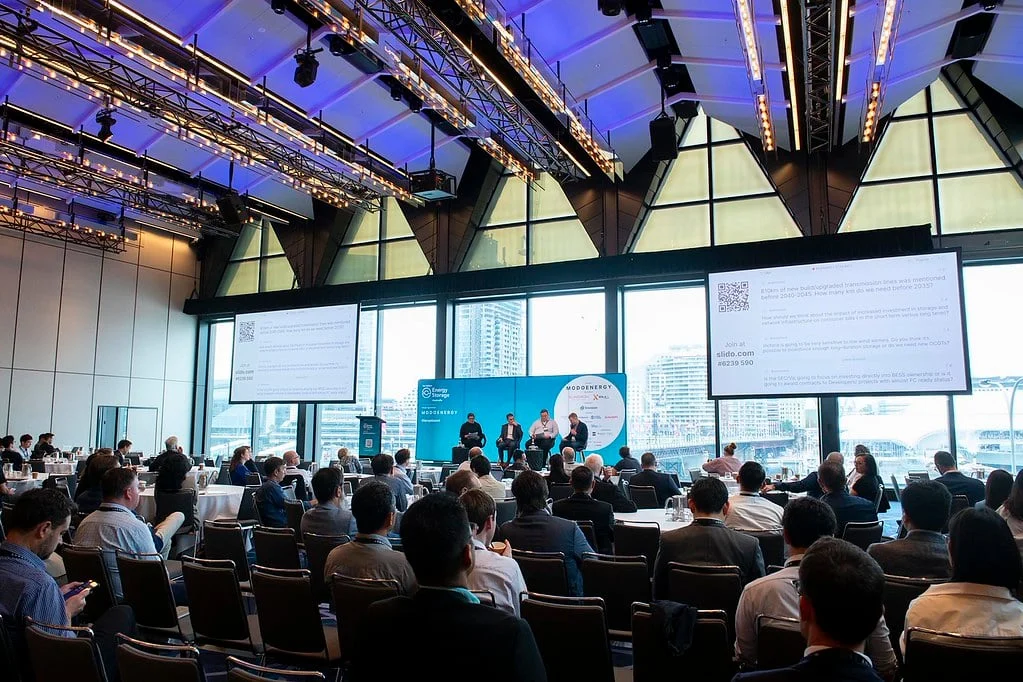
“Two years ago, we needed 40GWh of storage operational by 2030. That has now increased to 56GWh solely due to solar penetration. Of the 56GWh needed, 12.5GWh has hit the financial investment decision. 75% of what we need in 2030 is not there today,” Paul Peters, CEO of New South Wales’ Energy Security Corporation, said at the Energy Storage Summit Australia 2026 in Sydney last month.
Speaking alongside government representatives from Western Australia and Victoria, Peters outlined how a dramatic shift in the renewable energy generation mix, from wind-dominated to solar-heavy, has fundamentally altered storage requirements in ways that weren’t anticipated just two years ago.
Indeed, the panellists noted that New South Wales alone requires 37GWh to reach financial close by 2030, with 75% yet to secure investment. Victoria is targeting 6.3GW by 2035 and has already become the first state to exceed 1GW of simultaneous battery charging.
Meanwhile, Western Australia’s isolated grid, the South West Interconnected System (SWIS), has reached 90% instantaneous renewable energy penetration, with battery storage supplying a quarter of all electricity during peak demand.
The urgency stems from converging pressures. Coal power stations, contributing about half of New South Wales’ supply, are predicted to close by 2033-2034. Victoria’s three ageing coal plants still provide 60% of generation, but Yallourn closes in 2028 and Loy Yang A by 2035.
On the other side of the country, Western Australia must retire all state-owned coal by 2030, as stations dating back to 1985 run out of fuel. Meanwhile, electric vehicles (EVs) are proliferating, with New South Wales having just passed 100,000 EVs and estimates that a further four to five million will be on the roads by 2045, while data centre demand is set to grow substantially.
“Today, data centres consume just under 4TWh of electricity,” Peters said.
“The Integrated System Plan says we’re going to get another 2GW by 2035. I don’t think there’s a developer or major operator that wants that.”
Peters also noted that the generation mix shift has compounded storage requirements. Four years ago, planning assumed 75% of new renewable energy generation would be solar and 25% wind.
Reality has inverted this ratio, with 75% now solar across multiple states. This matters because solar generates for approximately eight hours daily while wind blows for 12 hours, meaning four additional hours of load must be covered by storage. That single factor added 16GWh to New South Wales’ 2030 storage requirement.
“Five years ago, batteries were a novel technology and weren’t being commercially deployed. Today, they’re essential to the reliability of the energy system,” Peters said.
Aggressive government intervention to accelerate deployment
Faced with these timelines, all three states are moving beyond setting targets to direct market intervention, though with markedly different approaches shaped by local circumstances.
New South Wales’ Energy Security Corporation is taking perhaps the most aggressive stance, filling three key market gaps that traditional project finance will not address.
First, capital structure: providing subordinated, hybrid-type instruments between senior debt and equity to enhance returns and allow projects to reach financial close. Second, time acceleration: “We are investing ahead of bank fit. We will fund long leads. We will go ahead with the final offer to connect. We will dial our debt service coverage ratio to deal with more merchant exposure,” Peters explained.
The goal is to bring projects forward by months. The organisation is also aiming to support projects that provide system-wide benefits but lack immediate price signals. Last year, the Energy Security Corporation outlined its intention to deliver AU$1 billion (US$640 million) in short- to long-duration energy storage projects as part of its first investment mandate.
Peters added that the organisation’s immediate priorities include 500MW of storage for the constrained Sydney-Newcastle region. However, he suggested the actual need is closer to 1-1.5GW, 2GW of long-duration storage in the next 18-24 months, in addition to solar-plus-storage projects, as increasing negative pricing drives demand for co-located battery storage
Further south, Victoria has taken a different path, creating institutional architecture to coordinate the transition while streamlining approvals. The relaunched State Electricity Commission, a government-owned renewable energy company, partners with private developers on priority projects.
It has already invested in the 600MW/1.6GWh Melbourne Renewable Energy Hub, which was brought online last year, alongside various other renewable energy projects.
But Victoria’s most effective tool may be its Development Facilitation Program, which was extended to renewable energy projects in April 2024.
“In less than two years, the development facilitation pathway has unlocked more than AU$9 billion in investment across 25 priority renewable energy projects,” said Vanya Kumar, executive director of innovation and investment attraction at Victoria’s Department of Energy, Environment and Climate Action.
“This includes battery projects with planning decisions made in less than four months from lodgement.”
Several major battery storage projects have been fast-tracked through this programme. This includes a 300MW/1,140MWh battery storage system in Heywood being pursued by Atmos Renewables, as well as Pacific Green’s 2,500MWh Portland Energy Park.
Western Australia’s approach reflects its unique position operating an isolated grid covering 350,000 square kilometres with significant government ownership of generation and retail.
Noel Ryan from Western Australia’s Department of Energy and Economic Diversification believes the SWIS has become a testbed for high renewable energy penetration, with renewables becoming the leading generation source for the first time in the final quarter of 2024, and the grid recording peak renewable energy contribution exceeding 90%.
“We now have 41% of houses with PV on their roofs, adding up to 2.5GW of generation,” Ryan noted.
The state’s approach includes a residential battery scheme offering AU$1,300 per system, which can be stacked with Commonwealth rebates, alongside major grid-scale investments, including a AU$150 million commitment to Australia’s first locally built vanadium battery.
The isolated grid creates a captive market with less competition from interstate projects, while government ownership provides clear counterparties for offtake agreements.
While 4-hour-duration battery storage systems are being deployed at scale across all three states, the panellists identified 8-hour-or-longer-duration storage as the next frontier, and a category where current market signals are not providing adequate investment signals.
AEMO’s Investment Opportunities Report identified New South Wales’ need for 44-81GWh of long-duration storage for winter periods when wind generation is low. The state needs approximately 2GW of 8-hour-or-longer systems, with the balance, potentially 7-8GW, in 4-hour battery storage systems.
“We need 7GW of long-duration storage, 44GWh. We are 400MWh into that target,” Peters said.
Kumar acknowledged that while Victoria’s 4-hour duration battery storage systems are scaling rapidly, “current market settings are not always providing the investment signals needed for timely deployment of long-duration energy storage.”